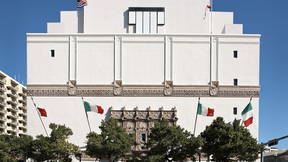
The Wolfsonian-Florida International University
The Wolfsonian–FIU, 1927
1001 Washington Avenue
Originally Washington Storage Company
Architects: Robertson & Patterson, 1927
Architect (addition): Robert M. Little, 1936
Architect: (renovation and addition): Mark Hampton, and William S. Kearns, associate, 1992
(Please see images 1, 2)
Start your tour at the entrance of The Wolfsonian–FIU. Built in 1927 to house the Washington Storage Company, the Mediterranean Revival building has undergone several renovations and additions in the decades since. After being purchased by Mitchell Wolfson, Jr., it opened to the public as a museum and research center in 1995 and became a part of Florida International University two years later.
(Please see image 3)
On the sidewalk just a few yards north of the entrance, you will see one of the two bridge tender houses that were installed on the Northwest 27th Avenue Bridge in Miami after its 1938–39 expansion. The hexagonal stainless-steel Art Deco structure was saved from demolition in the late 1980s when the bridge was rebuilt.
Bridge Tender House, 1939
Steel, wood, glass, iron, metal
Engineers: Harrington and Cortelyou
Kansas City, Missouri
The Wolfsonian–FIU, Gift of the Florida Department of Transportation, 1993.5
Taft Hotel
Taft Hotel, 1936
1040 Washington Avenue
Architect: Henry Hohauser (American, 1895–1963)
(Please see images 1, 2)
The acanthus, a plant that originated in the Mediterranean region, appears frequently in ancient Greek and Roman ornament. Deco designers borrowed and simplified the acanthus leaf motif, giving it the highly stylized form it takes in the brass-plated relief by Mario Moschi and the decoration over the entrance to Henry Hohauser’s Taft Hotel.
(Please see image 3)
Plaque, 1929–32
Brass plate
Sculptor: Mario Moschi (Italian, 1896–1971)
Florence, Italy
The Mitchell Wolfson, Jr. Private Collection, Miami, Florida, 84.9.20.2 NC
Kenmore Hotel
Kenmore Hotel, 1936
1050 Washington Avenue
Architect: Anton Skislewicz (American, born Croatia, 1895–1980)
(Please see image 1, 2)
The stacked lines that decorate the Kenmore Hotel echo the streamlined minimalism of the Sunbeam toaster. In both cases, the goal is to emphasize form with an economy of ornament. The lines running along the front of the toaster recall the design of Art Deco skyscrapers, and the decoration on the Kenmore façade does something similar, drawing the eye upward to produce a feeling of vertical rise.
(Please see image 3)
Toaster, Sunbeam Silent Automatic, model no. T-1-C, 1935
Chrome-plated steel, Bakelite
Designer: Alfred F. Fukal (American, 1896–1974)
Manufacturer: Chicago Flexible Shaft Co., Chicago
The Wolfsonian–FIU, Gift of Juda Greenzaid, 2010.5.3
Palmer House
Palmer House, 1939
1119 Collins Avenue
Architect: Lawrence Murray Dixon (American, 1901–1949)
(Please see images 1, 2)
The fluting motif in the green limestone pilasters framing the entryway of the Palmer House widens into vertical stripes leading to the corner lighthouse finial, a typical element of many Miami Beach Art Deco hotels. Similar abstracted classical detailing characterizes the rounded surface of the iconic Diplomat coffee service designed by German émigré Walter von Nessen.
(Please see image 3)
Coffee Service, Diplomat, 1933
Chrome-plated copper, Catalin
Designer: Walter von Nessen (American, b. Germany, 1889–1943)
Manufacturer: Chase Brass & Copper Company, Waterbury, Connecticut
The Wolfsonian–FIU, The Mitchell Wolfson, Jr. Collection, TD1991.84.1
Congress Hotel
Congress Hotel, 1935
1036 Ocean Drive
Architect: Henry Hohauser (American, 1895–1963)
(Please see image 1)
The bold round shapes of the Congress Hotel’s lettering evoke a machine-age aesthetic, also conveyed by the industrial designer John Vassos on the cover of his book Contempo. The hotel’s architecture, like many in the neighborhood, combines Art Deco’s vertical emphasis, in its ascending central fin, with streamlined horizontal features, such as the projecting “eyebrows” and corner ribbon windows.
Book, Contempo: This American Tempo, 1929
Designer: John Vassos (American, b. Romania, 1898–1985)
Author: Ruth Vassos (American, 1893–1965)
Publisher: E. P. Dutton & Company, Inc., New York
The Wolfsonian–FIU, The Mitchell Wolfson, Jr. Collection, 83.2.833
(Please see image 2)
Introduced at the 1925 Paris exposition, the “frozen fountain” became an Art Deco leitmotif. You can find examples in the bas-relief panels on each side of the entrance of the Congress Hotel, and—on a monumental scale—in The Wolfsonian’s lobby. The Wolfsonian’s frozen fountain was originally on the façade of the Norris Theater, which was demolished in 1983 to make way for a McDonald’s. Architect Mark Hampton chose it as a centerpiece for the museum’s lobby, integrating it into a real fountain.
Window grille, 1929
Glazed terracotta
From the Norris Theatre, Norristown, Pennsylvania
Architects: William Harold Lee (American, 1884–1971) and Armand Carroll (American, 1898–1976)
Manufacturer: Conkling-Armstrong, Philadelphia
The Wolfsonian–FIU, The Mitchell Wolfson, Jr. Collection, XX1989.429
The Congress Hotel is a variant of the Colony Hotel, on 736 Ocean Drive, designed by the same architect one year earlier. Look for its neon lettering at night.
Essex House Hotel
Essex Hotel, 1938
1001 Collins Avenue
Architect: Henry Hohauser (American, 1895–1963)
(Please see image 1)
While at the Essex, step onto the front terrace and look down. Terrazzo is a composite material made of marble, glass, and quartz chips mixed with a cement binder. Different groupings and colors of chips allow a designer to create a pattern in the terrazzo, such as the shapes and words embedded in terrazzo floors and hotels throughout South Beach. The pattern on the Essex Hotel terrace, like the cover of the catalog A Century of Progress Homes and Furnishings, uses geometric shapes and diagonal lines to give a sense of speed and direction. The catalog was published in conjunction with the 1933 Century of Progress exposition in Chicago, which inspired much of South Beach’s architecture.
Radio, Sparton, model 558-C, 1937
Glass, brass, wood, Bakelite
Designer: Walter Dorwin Teague (American, 1883–1960)
Manufacturer: Sparton Corporation, Jackson, Michigan
The Wolfsonian–FIU, The Mitchell Wolfson, Jr. Collection, XX1990.1484
(Please see image 2)
While at the Essex, step onto the front terrace and look down. Terrazzo is a composite material made of marble, glass, and quartz chips mixed with a cement binder. Different groupings and colors of chips allow a designer to create a pattern in the terrazzo, such as the shapes and words embedded in terrazzo floors and hotels throughout South Beach. The pattern on the Essex Hotel terrace, like the cover of the catalog A Century of Progress Homes and Furnishings, uses geometric shapes and diagonal lines to give a sense of speed and direction. The catalog was published in conjunction with the 1933 Century of Progress exposition in Chicago, which inspired much of South Beach’s architecture.
Catalog, A Century of Progress Homes and Furnishings, c. 1934
Editor: Dorothy Raley
Publisher: M. A. Ring Company, Chicago
The Wolfsonian–FIU, The Mitchell Wolfson, Jr. Collection, 83.2.1093
Franklin Hotel
Franklin Hotel, 1934
860 Collins Avenue
Architect: Victor Nellenbogen (American, b. Hungary, 1888–1959)
(Please see images 1, 2)
Flowers and leaves, simplified and flattened to create two-dimensional ornament, were among the most common motifs of Art Deco design. Similar patterns could be applied to objects as different as a bowl sold by the French department store Le Bon Marché and an architectural frieze on the Franklin Hotel. Like many Deco buildings, the Franklin also looks back to historical forms, from the arched windows on the ground floor to the Classical references of the entrance portico.
Bowl, c. 1929
Enameled earthenware
Manufacturer: Longwy, Longwy, France, for Atelier Pomone du Bon Marché, Paris
The Wolfsonian–FIU, The Mitchell Wolfson, Jr. Collection, 85.7.282
Hotel Shelley
Hotel Shelley (originally Hotel La Salle), 1931
844 Collins Avenue
Architect: Henry J. Moloney (American 1885–1949)
(Please see images 1, 2)
Some Deco objects, such as the silver-plated tray designed by Albert F. Saunders, were ornamented with overlapping triangles to create a jagged, dynamic feeling. A similar pattern, mixed with leaf and floral forms, can be found on bas-reliefs over the entrance to the Hotel Shelley. The zigzag pattern on the building’s cornice, just below the roof, is another feature that was popular in both architecture and decorative arts of the time.
Tray, 1928
Silverplate, Bakelite
Designer: Albert F. Saunders (British, 1878–1964)
Manufacturer: Benedict Manufacturing Corporation, East Syracuse, New York
The Wolfsonian–FIU, Gift of Jewel Stern, 2010.4.4