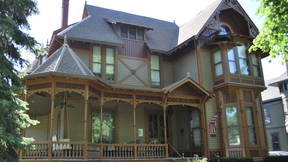
Old Northside Neighborhood Preview

Access this tour for free

Experience this tour for free. Available through our app.

Download or access the app

iOS Android Web
1

1210 Central Avenue

Year Built: 1898

Architecture Style:

Key Features:

  • Palladian and Porthole Windows
  • Shingle and Clapboard Siding
  • Hipped Front Gable Roof

This home is considered infill. The home successfully matches the older homes in the neighborhood.

2

Oran Perry House - 1218 Central Avenue

Year Built: 1903

Architecture Style: Queen Anne

Key Features:

  • Bay Windows
  • Star Leading on Upper Windows
  • Claboard Siding

When constructed in 1903, this home was configured as a duplex.

3

Indiana Landmarks Center - 1201 Central Avenue

Year Built: 1891

Architecture Style: Romanesque Revival

Key Features:

  • Large Stained Galss Window
  • Heavy Stone Construction
  • Dome and Bell Tower

The current home of Indiana Landmarks is the restored Central Avenue Methodist Church. There were additions to the building in 1900 and 1922. The building fell into disrepair, but was restored by Indiana Landmarks when they purchased the property. Historic Urban Neighborhoods of Indianapolis is an affiliate organization of Indiana Landmarks.

"Founded in 1960, Indiana Landmarks is proud of our status as the largest statewide preservation organization in the U.S.

In 1960, Hoosier civic and business leaders founded Historic Landmarks Foundation of Indiana, renamed Indiana Landmarks in 2010, to preserve significant sites for the benefit of present and future generations. The inaugural co-chairmen—Eli Lilly and Herman Krannert—ensured a promising degree of respect and clout.

Indiana Landmarks’ first project, the restoration of the Second Empire-style Morris-Butler House in Indianapolis, also served the broader purpose of revitalizing a run-down area. Later known as the Old Northside, it’s one of many neighborhoods we’ve revitalized as historic districts in Indianapolis and elsewhere.

By the mid-1970s, Indiana Landmarks had expanded programs and outreach, establishing innovative real estate programs to rescue endangered properties and use landmarks as the basis for community revitalization.

We’ve sparked the creation of local non-profit preservation organizations, providing crucial financial, strategic, and staff support at key moments. Indiana Landmarks’ commitment to empowering local leadership can be seen in the 62 local organizations formally affiliated with Indiana Landmarks and nearly 50 local preservation commissions in our state.

We also developed educational programs, workshops, tours, awards, a magazine, e-letters and social media networks to increase Hoosiers’ awareness of landmarks and the importance of stewardship and preservation.

A private organization not affiliated with government, Indiana Landmarks grew from an all-volunteer force to a membership-based nonprofit with professional staff in an Indianapolis headquarters and nine regional offices who help Hoosiers save and repurpose old buildings and revitalize neighborhoods and downtowns."

To learn more about this space, visit the Indiana Landmarks website: https://www.indianalandmarks.org/

4

George N. Munfeld House - 1235 Central Avenue

Year Built: 1897

Architecture Style: Gable Front

Key Features:

  • Palladian Window
  • Fish Scale and Clapboard Siding
  • Small Crowns over Windows
5

1241 Central Avenue

Year Built: 2000

Architecture Style: Italianate Inspired

Key Features:

  • Decorative Brackets on Roof Line
  • Low Pitched Roof
  • Striped Brick Design

This home is an Italianate inspired infill property. Near the entrance, the owners have placed an eclectic grotesque figure.

6

Howe-Sheil House - 1304 Central Avenue

Year Built: 1901

Architecture Style: Colonial Revival

Key Features:

  • Large Wrap Porch
  • Decorative Spindling and Colorful Trim
  • Pointed Arch Ribbon Windows and Bay Windows

This home is now a bed and breakfast, The Stone Soup Inn. You can visit their webpage to learn more about the Inn: https://www.stonesoupinn.com/

The home was originally constructed as an apartment home with several different living spaces.

7

Maryden Apartments - 1308 Central Avenue

Year Built: 1920

Architecture Style: Gothic Revival

Key Features:

  • Double Towers with Parapet
  • Heavy Stone and Brick Construction
  • Gothic Door Archway with Elaborate Door Surround
8

J. George Mueller House - 1321 Central Avenue

Year Built: 1888

Architecture Style: Queen Anne

Key Features:

  • Fish Scale Siding
  • Hipped Gable Roof
  • Large Wrap Porch
9

H.P. Lieber House - 1415 Central Avenue

Year Built: 1908

Architecture Style: Eclectic Tudor Revival

Key Features:

  • Decorative and Colorful Timbering
  • Tiled Roof
  • Bay Windows

This property was once home to the Psychic Science Spiritualist Church. The carriage house behind this massive home expertly follows the design and color scheme.

Herman P. Lieber was a prominent businessman and civic leader. As one of the German free thinkers of the time, much of his philosophy and social values are incorporated in the building. He lived here with his family until 1939.

The interior and stained glass windows exemplify the Arts and Crafts Movement. They were designed and completed by the versatile architect and artist Brandt Steele, son of Indiana artist T.C. Steele.

Dr. Benjamin F. Clark and Rev. Dollie Clark acquired the property in its original state for the home of the Psychic Science Spiritualist Church. A few minor changes were made to the interior to adapt the home for its present use, while retaining its unique beauty and symbolism. The church was dedicated March 15, 1942 and has served the community since that time. The peony garden dates back to the initial landscaping.

10

Allen, Pfeiffer, Weems, De Prez House - 1412 Central Avenue

Year Built: 1897

Architecture Style: Queen Anne

Key Features:

  • Large Turret Tower
  • Clapboard Siding
  • Large Wrap Porch

On the North part of Lot 1 of Holman's Addition to the City of Indianapolis (platted in 1872) and next to the 1870's home which already occupied Lot 1, this home was built by Henry Clay Allen, a lawyer and judge. It reflects several architectural styles: Greek, Colonial, and Queen Anne, with a round tower and wrap-around front porch. The fancy cut limestone porch skirts are original.

In 1905 Gustav A. Pfeiffer, owner of the prestigious Columbia Grocery Co., took up residence. The 1920s brought a rear addition and conversion into apartments. Eventually it was divided into eight apartments.

In 1985, the gutted and vandalized structure was saved from destruction by James A. Weems, CRCST, and De Perez, a lawyer and judge.

11

513 East 14th Street

Year Built: Circa Late 1800s

Architecture Style: Gable Front

Key Features:

  • Clapboard Siding
  • Narrow Footprint
  • Full Facade Length Porch

This home is off the small alley that is 14th street. These alley ways would have originally been used for deliveries to homes and businesses.

12

Matlock Swift House - 517 East 14th Street

Year Built: 1889

Architecture Style:

Key Features:

  • Stars for Tie Rods
  • Two Dormers
  • Brick Construction

This small home was converted from a carriage house.

13

John B. Elam House - 1340 North Park Avenue

Year Built: 1888

Architecture Style: Queen Anne

Key Features:

  • Large Tower with Pedimented Dormers
  • Decorative Flourishes on Window Crowns and Vergeboard
  • Central Skylights

This building was once home to a Montessori Academy. The home has very unusual Queen Anne features, such as carved stone is featured on lintels, a weather vane, and brick construction.

14

Raney-Riffle House - 1400 North Park Avenue

Year Built: 1874

Architecture Style: Italianate

Key Features:

  • Keystones over Fully Arched Windows
  • Decorative Entablature on Roofline
  • Low Pitched Roof

This home has been heavily remodeled from the original structure, yet retains much of its Italianate heritage.

15

Raney-Dowling House - 1406 North Park Avenue

Year Built: 1874

Architecture Style: Italianate

Key Features:

  • Fanlights Over Several Doors
  • Decorative Brackets and Entablature on Roof Line
  • Fully Arched Windows On Second Story

This is another Italianate home which has been heavily remodeled.

16

Everts-Paddock House - 1410 North Park Avenue

Year Built: 1873

Architecture Style: Italianate Cottage

Key Features:

  • Decorative Brackets and Spindling
  • Wrap Porch
  • Decorative Vergeboard on Porch Gable
17

Great Oak Commons Park

The Great Oak Commons is a Victorian Walking Park that is open to the public. The park hosts many community events such as outdoor plays and social gatherings.

If you need a small break, this is a great place to stop and enjoy!

18

McAlpine-Brown House - 1415 North Park Avenue

Year Built: 1893

Architecture Style: Queen Anne

Key Features:

  • Decorative Timbering
  • Fish Scale, Wave, and Shingle Siding
  • Large Porch with Many Decorative Flourishes
  • Jewel Tone Color Scheme
19

Lupton-Taylor House - 1409 North Park Avenue

Year Built: 1882

Architecture Style: Italianate-Stick

Key Features:

  • Inward Sloping Piers on Large Wrap Porch
  • Low Pitch Roof
  • Decorative Design with Windows and Siding
20

Colgan-Lieber-Koehne House - 1332 North Park Avenue

Year Built: 1889

Architecture Style: Shingle

Key Features:

  • Stickwork and Clapboard Siding
  • Squared Railing on Porch
  • Brackets on Porch Supports
21

1335 & 1337 North Park Avenue

Year Built: 1880s

Architecture Style: Victorian

Key Features:

  • Large Wrap Porch with Simple Columns
  • Simple Crown over Windows
  • Wide Porch Staircase

In the 1970s, three Victorian houses on Park Avenue were stripped down, covered with stucco, cobbled together with makeshift connectors, and converted into substandard public housing. Through the efforts of the Old Northside Foundation, these properties were saved from demolition and have been restored as single-family homes.

22

1323 North Park Avenue

Year Built: 1900

Architecture Style: Victorian

Key Features:

  • Large Tower
  • Decorative Brackets on Roof Line
  • Shingle Siding
  • Facade Width Porch

In the 1970s, three Victorian houses on Park Avenue were stripped down, covered with stucco, cobbled together with makeshift connectors, and converted into substandard public housing. Through the efforts of the Old Northside Foundation, these properties were saved from demolition and have been restored as single-family homes.

23

1321 North Park Avenue

Year Built: 1895

Architecture Style: Victorian

Key Features:

  • Diamond Pattern Leading in Windows
  • Large Porch
  • Dentils

In the 1970s, three Victorian houses on Park Avenue were stripped down, covered with stucco, cobbled together with makeshift connectors, and converted into substandard public housing. Through the efforts of the Old Northside Foundation, these properties were saved from demolition and have been restored as single-family homes.

24

Bradbury-Hoffman House - 1317 North Park Avenue

Year Built: 1900

Architecture Style: Queen Anne

Key Features:

  • Hipped Roof and Dormer
  • Exposed Roof Beams
  • Large Porch with Unique Supports
25

Historic Ovid Butler Home / Forest Home - 1306 North Park Avenue

Year Built: 1848

Architecture Style: Colonial Revival

Key Features:

  • Symmetrical Design
  • Double Columns on Double Porch
  • Elaborate Dormers

Ovid Butler was a lawyer, abolitionist, journalist, and founder of North Western Christian University, which was later renamed Butler University in his honor. In 1846, Butler retired from the practice of law, and built this house on farmland on the outskirts of Indianapolis. The former site of his farm comprises the entire eastern half of The Old Northside, including land at 13th & College that served as the first site of Butler University. Eventually, after several years in the Irvington area, Butler University moved in 1928 to its present-day home on Sunset Avenue in the Butler Tarkington Neighborhood.

Take time to read the Historic marker on this property.

26

604 East 16th Street

Year Built:

Architecture Style: Tudor Revival

Key Features:

  • Stucco and Timbering
  • Exposed Roof Beams
  • Red Trim
27

612 East 13th Street

Year Built:

Architecture Style: Italianate

Key Features:

  • Decorative Brackets and Low Pitch Roof
  • Attic Level Story
  • Arched Windows with Keystones
28

Butler/Newman House - 620 East 13th Street

Year Built: 1872

Architecture Style: Italianate

Key Features:

  • Attic Level Windows
  • Decorative Double Brackets
  • Stained Glass Window Over Door

These side-by-side houses (620 & 630) were originally built for Butler’s sons. The house on the right was later owned by Bernard Vonnegut, the first licensed architect in Indiana.

29

Butler/Vonnegut House - 630 East 13th Street

Year Built: 1872

Architecture Style: Italianate

Key Features:

  • Attic Level Windows
  • Decorative Spindling on Porch
  • Small Paned Windows

These side-by-side houses (620 & 630) were originally built for Butler’s sons. The house on the right was later owned by Bernard Vonnegut, the first licensed architect in Indiana.

30

Jameson/Morris House - 1422 Broadway Street

Year Built: 1876

Architecture Style: Gothic Revival

Key Features:

  • Decorative Detailing on Porch
  • Iron Cresting on Roof
  • Exposed Roof Beams
  • Multi-Colored Keystones over Windows

Dr. Patrick H. Jameson, a prominent physician who served as a military surgeon during the Civil War and later as Commissioner of the Indiana Hospital for the Insane, was this home’s original owner. By 1970, the house had been broken up into 11 apartments and had served at various times as a brothel. It was subsequently abandoned and purchased on a credit card by two men who wanted to host a Halloween party in a “scary” house. Check out the gargoyle on the roof.

31

Townley/Metzger House - 1508 Broadway Street

Year Built: 1876

Architecture Style: Queen Anne - Stick

Key Features:

  • Stick Work
  • Decorative Wooden Frieze on Large Wrap Porch
  • Decorative Wooden Vergeboard

Before restoration, this 1876 house was carved into 11 apartments with a Pepsi machine in the yard. It has been converted back into a single family home

32

Merrill House - 1522 Broadway Street

Year Built: 1878

Architecture Style: Queen Anne

Key Features:

  • Diamond Saped Leading in Windows
  • Bay Windows
  • Garland Detailing
  • Balustrade on Top of Porch

General Samuel Merrill built this house in 1878. His father was the state treasurer who moved the Indiana State Capitol to Indianapolis in 1825.

33

636 East 13th Street

Year Built: 1873

Architecture Style: Italianate

Key Features:

  • Decorative Brackets on Roof and Windows
  • Clapboard Siding
  • Crowns and Simple Frieze Above Windows
34

1241 Broadway Street

Year Built: 1900

Architecture Style: Queen Anne

Key Features:

  • Terra Cotta Detailing
  • Carved Stonework Above Windows
  • Decorative Woodwork on Porch
35

1233 Broadway Street

Year Built: 1900

Architecture Style: Queen Anne

Key Features:

  • Fish Scale Siding
  • Exposed Roof Beams
  • Small Panes on Windows
36

1229 Broadway Street

Year Built: 1900

Architecture Style: Queen Anne

Key Features:

  • False Dentiling on Siding
  • Diamond Decoration
  • Clapboard Siding
37

O’Bannon Home - 1226 Broadway Street

Year Built: 1865

Architecture Style: Queen Anne

Key Features:

  • Wrap Porch
  • Tower With Rounded Roof
  • Decorative Spindling on Porch

This was the home of Indiana Governor Frank O'Bannon until the time of his death in 2003. Governor O'Bannon was elected Indiana's 47th Governor in 1997 and served until 2003. He grew up in Corydon Indiana -- Indiana's first state capitol. He attended Indiana University where he met his wife Judy. Judy O'Bannon has a long history of activism and supporting public causes of significance to Hoosiers.

38

1239 North Park Avenue

Year Built: 2000

Architecture Style:

Key Features:

  • Decorative Feature on Front Dormers
  • Brick Construction
  • Decorative Balustrade on Porch

This home is another recently constructed home.

39

Gerstner-Dalrymple House/Saenger-Chor - 1238 North Park Avenue

Year Built: 1873

Architecture Style: Italianate

Key Features:

  • Large Wrap Porch
  • Decorative Brackets and Attic Windows
  • Rounded Tower

This mansion was recently restored after serving nearly 60 years as the home of the Saenger Chor, a German singing society.

40

1232 North Park Avenue

Year Built: 1900

Architecture Style: Queen Anne

Key Features:

  • Decorative Garland Details
  • Large Wrap Porch
  • Jewel Tone Color Scheme
41

Genesee Apartments - 1227 North Park Avenue

Year Built: 1953

Architecture Style: Colonial Revival

Key Features:

  • Decorative Spindling On Porches
  • Full Arch and Elaborate Door Surround
  • Symmetrical Aesthetic
42

DeWolf–Allerdice House - 1224 North Park Avenue

Year Built: 1873

Architecture Style: Italianate

Key Features:

  • Decorative Brackets
  • Low Pitched Roof
  • Crowns Over Windows

This house fell into decay after it was chopped up into seven apartments in the 1960s. It served for many years as a Bed and Breakfast but is now a single-family home.

43

1205 North Park Avenue

Year Built: 1993

Architecture Style: International Style

Key Features:

  • Decorative Stonework
  • Squared Aesthetic in Windows
  • Low Pitched Roof
44

Morris-Butler House - 1204 North Park Avenue

Year Built: 1862

Architecture Style: Second Empire

Key Features:

  • Dual Pitched Hipped Roof
  • Central Tower
  • Dormers on Roof
  • Arched Windows and Door Surround

The Morris-Butler House in Indianapolis takes its name from two families who lived there in the nineteenth century. In 1864, John Morris commissioned the construction of his home on land once owned by Ovid Butler, the founder of Butler University.

Morris was one of the first to move to the new suburb north of downtown. The area quickly became the city’s most fashionable place to live. The Morris family occupied the house until 1878. Noble Butler, a bankruptcy lawyer, moved into the Second Empire-style house three years later with his wife and seven children. The family stayed until Florence Butler, the youngest daughter, died in 1957. Her survivors emptied the house and held an estate auction.

By then, the neighborhood was no longer viewed as an enviable place to live. A majority of the large homes had been divided into apartments during and after World War II, and most were dilapidated. By the mid-1970s, over half of the original houses had been demolished.

In 1964, Indiana Landmarks—then known as Historic Landmarks Foundation of Indiana—rescued the deteriorated house. Eli Lilly, a founder of Indiana Landmarks, funded the purchase and the five-year restoration directed by architect H. Roll McLaughlin, also a founding board member. Mr. Lilly also paid for the home’s Victorian furnishings. Indiana Landmarks opened the Morris-Butler House as a museum in 1969.

You may notice how I-65-70 curves as it approaches downtown from the east. That curve demonstrates the power of preservation and Indiana Landmarks, which convinced transportation officials planning the interstate construction in the early 1970s to spare rather than demolish the National Register-listed Morris-Butler House. Lobbying to save Morris-Butler House also spared what was then Central Avenue United Methodist Church, now Indiana Landmarks Center.

The restoration of Morris-Butler House, followed by the listing of the entire neighborhood—called the Old Northside—in the National Register of Historic Places, acted as catalysts for the revitalization of the area. In the early 1980s, Indiana Landmarks partnered with the Junior League of Indianapolis to rescue and resell houses with protective covenants, concentrating initially in the Old Northside.

The revolving fund that financed the program later expanded to other areas and is now known as our Efroymson Family Endangered Places Fund. And the Old Northside is once again an enviable residential neighborhood, where restored historic houses blend with new homes filling the empty lots created by the demolitions of the 1950s and 1960s.

In the twenty-first century, Indiana Landmarks’ board, with the blessing of H. Roll McLaughlin and other early supporters, voted to cease operating Morris-Butler House as a museum, a use which had never achieved visitation adequate to offset maintenance and staffing. It is now used as an event venue.

To learn more about the home, visit thier website: https://www.indianalandmarks.org/our-historic-sites/indiana-landmarks-center-campus/rent-a-venue/morris-butler-house/

This is the last stop on our tour!

Historic Urban Neighborhoods of Indianapolis and Indiana Landmarks thanks you for joning us! Consider taking one of other fantasic tours on PocketSights!

Old Northside Neighborhood
44 Stops