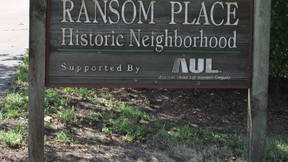
Ransom Place Neighborhood Preview

Access this tour for free

Experience this tour for free. Available through our app.

Download or access the app

iOS Android Web
1

1042 Doctor Martin Luther King Junior Street

Year Built: 1875

Architecture Style: Gabled- Ell

Key Features:

  • Wood Shingle Siding
  • Large Closed Porch
  • Decorative Brackets

This home is actually two! The larger home is three units and there is a smaller wood frame cottage in the back. This home retains many original features and is the most intact of the three here along MLK. These features include brackets, porches fireplaces, and a coal shoot.

The cottage built to accommodate new arrivals from the south and returning WWII veterans.

One former resident was Henry Fleming, a political operative, businessman, and golfer. He saved block from demolition in 1947. His wife, Virginia Fleming, hosted literary club at the home.

2

1038 Doctor Martin Luther King Junior Street

Year Built: 1875

Architecture Style: Gabled- Ell

Key Features:

  • Brick Porch
  • L-Shape Footprint
  • Wide Second Story Windows

The home is three units total. The back porch was converted into additional unit mid 1990s. Little of the original details remain.

One past resident of this home was Lillian LeMon, a nationally renowned music educator. She was the founder of the Cosmopolitan School of Music and Fine Arts and a founding member AKA Sorority.

3

1034 Doctor Martin Luther King Junior Street

Year Built: 1975

Architecture Style: Gable Front

Key Features:

  • Clapboard Siding
  • Symmetrical Design
  • Brackets on Roof Line

This home was original a single family home, but has since been converted into a double home. The front porch was closed and incorporated into the living space. At one point, the Sisters of Charity State Headquarters were located here.

4

Dunbar Court Apartments - 1022 Doctor Martin Luther King Junior Street

Year Built: 1923

Key Features:

  • Masonry Construction
  • Symmetrical Design
  • Narrow Windows

The Dunbar Court apartment building made up of 43 units and was originally designed as a winter home ofr many of Indianapolis' more rural residents.

5

Greater Gethsemane Missionary Baptist Church - 902 Doctor Martin Luther King Junior Street

Year Built: 1976

Architecture Style: Colonial Revival

Key Features:

  • Steeple
  • Symmetrical Facade
  • Narrow Windows

The Greater Gethsemane Missionary Baptist Church was founded in 1926. The original church building burned down. It was replaced with the current structure in 1976.

6

Heritage Learning Center - 830 Doctor Martin Luther King Junior Street

Year Built: 1836

Architecture Style: Colonial Revival

Key Features:

  • Large Central Pediment
  • Narrow Windows with Crowns
  • Elaborate Door Surround with Sidelights

This is the Heritage Learning Center for Ransom Place. This home was originally located on the Northwest quadrant of the Circle in Indianapolis. It was originally constructed to serve as the Governor's mansion after the Governor's mansion in the center of the Circle was deemed unfit by a former first lady.

It was later owned by the English family, who relocated the home in order to construct the English Hotel and Opera House. Before resting in its current location, the home was located at 1217 Doctor Martin Luther King Junior Street.

The home's previous owners include the McCormick family, the first white settlers of Indianapolis, and the New Baptist Church.

Read more about the home in this research paper: file:///Users/karachinn/Downloads/Musuem%20-%20MLK.pdf

7

815 North California Street

Year Built: 1895

Architecture Style: Stick Style

Key Features:

  • Fish Scale and Dentil Siding
  • Narrow Windows with Shingle Style Trim
  • Small Square Porch
8

847 North California Street

Year Built: 1910

Architecture Style: Queen Anne

Key Features:

  • Fish Scale Shingles
  • Decorative Window Crowns
  • Decorative Brackets

The home still features its original two-over-two and one-over-one double-hung sash windows, decorative shingles, and gingerbread trim. This home was also an Indiana Landmarks Flip House. Cutaway corners on the front gable which form a three-sided bay window.

9

947-949 Camp Street

Year Built: 1900

Architecture Style: Queen Anne

Key Features:

  • Spindle Porch Supports
  • Multi-Colored Jewel-Tone Paint Scheme
  • Stickwork Trim
10

945 Camp Street

Year Built: 1875

Architecture Style: Gable Front

Key Features:

  • Crowns Above Door and Window
  • Clapboard Siding
  • Attic Vents
  • Decorative Brackets

This simple construction home has retained much of its original details. This home is a "twin" to its neighbor 943 Camp Street. They were built on half lots.

11

943 Camp Street

Year Built: 1875

Architecture Style: Gable Front

Key Features:

  • Crowns Above Door and Window
  • Clapboard Siding
  • Attic Vents
  • Decorative Brackets

This simple construction home has retained much of its original details. This home is a "twin" to its neighbor 945 Camp Street. They were built on half lots.

12

921 Camp Street

Year Built: 1875

Architecture Style: Shotgun with Queen Anee Detialing

Key Features:

  • Spindlework Frieze on Porch
  • Tri-Color Painting
  • One Room Width

There is a second story addition on the back of the house. This house is "twins" with its neighbor 919 Camp Street.

13

919 Camp Street

Year Built: 1875

Architecture Style: Shotgun with Queen Anne Detailing

Key Features:

  • Decorative Fan Brackets
  • Jewel Tone Paint
  • Clapboard Siding

This original Shotgun style home has a second story addition on the back. This house is "twins" with its neighbor 921 Camp Street. They were both constructed on a half lot, notice thier extreme closeness.

14

Spears Home - 849 Camp Street

Year Built: 1910

Architecture Style: Queen Anne

Key Features:

  • Jewel Tone Paint
  • Wood Carved Frieze on Porch and Spindle Porch Supports
  • Decorative Brackets

Ransom Place also owes its existence to Jean Spears, a visionary preservationist, who through her sheer determination rescued - after years of neglect by the city - what was left of the neighborhood. Like the Project A owners, Jean Spears stood up and declared “Our Homes Have Value”.

15

833-835 Camp Street

Year Built: 1894

Architecture Style: Queen Anne

Key Features:

  • Fish Scale Siding
  • Tri-Color Paint
  • Crowns over Windows

This home was converted into a double. It has a full-width porch, one over-one double-hung sash window with flat surrounds and asbestos roof shingles.

16

Second Christian Church - 702 West 9th Street

Year Built: 1910

Architecture Style: Craftsman

Key Features:

  • Large Overhanging Roof
  • Exposed Rafters and Purlins
  • Stained Glass Windows
  • Timbering
  • Decorative Vergeboard


This, now residence, was originally was the Second Christian Church.

17

Paca Street Homes

The homes along Paca street are infill, market rate homes built with subsidies. They were constructed in the late 1990s and have slightly larger lots than the older homes in the area.

The infill housing on Paca Street was compromise of sorts. By the mid 1990‘s most of the buildings on Indiana Avenue had been bulldozed including the homes on Paca, St. Clair and 9th Streets. Originally to accommodate the increasing numbers of commuters the plan had been to build a Paca Street thoroughfare linking 11th and 10th Streets to Blackford Street.

However heeding to the voices of preservationists and the residents, new, infill housing was built by BOS, the area Community Development Corporation on the east side of Paca Street. These houses were situated on larger lots, with a few custom designed homes.

18

Ransom Place Pocket Park - North Alley 750 West

This pocket park was part of the Keep Indianapolis Beautiful and Indianapolis Power and Light "Project Green Spaces" in 2016, which was funded by the Lacy Foundation. The small park was designed by the Synthesis Group and photo panels were donated by the Indiana Historical Society.

The park pays homage to the larger neighborhood and its dedication to education, land use, and placemaking. It is a former site of a store and residence.

The property was excavated in 2000 by the IUPUI Archeology Field School. An Historical Marker recognizes the community and corner stores of Indianapolis’ Near-Westside

Ransom Place Neighborhood
18 Stops