The Cenotaph
- Built in 1923
- Located in Central
- The earliest memorial honouring those who fell defending Hong Kong in the First World War
- Inscribed with the words "The Glorious Dead" and "1914-1918"
- The years "1939-1945" were later added to honour victims of the Second World War
- The Chinese characters 英魂不朽 浩氣長存 ("May their martyred souls be immortal, and their noble spirits endure") were added in the 1970s to commemorate those who lost their lives during the Japanese invasion
- During British rule, Liberation Day celebration took place here on the last Monday in August to commemorate the Liberation of Hong Kong from Japanese occupation in 1945
- No official ceremonies have taken place here since 1997
- Liberation Day is no longer a general holiday in Hong Kong
- Commemorative activities are still held at there each year
- The Antiquities Authority has declared it as monuments under the Antiquities & Monuments Ordinance in 2013
Former French Mission Building
Located on Government Hill at 1 Battery Path, Central
A declared monument
housed the Court of Final Appeal of Hong Kong from 1 July 1997 to 6 September 2015
Three-storey building of Neo-Classical style
Constructed in granite and red bricks
Interior design:
Wooden staircase
Vaulted ceilings
Ornate columns
1842 - completed and named as “Johnston’s House”, with two storeys
1843 to 1846 – Sir Henry Pottinger resided there
1846 to 1848 - Used as temporary accommodation for the Supreme Court
1860 - Expanded into a three-storey building
1882 - Renamed “Beaconsfield”
1897 to 1911 - Leased by the government for use as different offices
1915 - Renamed “French Mission Building”
1941 to 1945 - Occupied by Japanese Army
1945 to 1997 - various usages during this period, for example:
temporary headquarters of the government
offices for various government departments
Victoria District Court
Supreme Court
1989 - Declared a monument
Provided to law-related organisations to facilitate their setting up and developing services in Hong Kong
Interior is not open to public
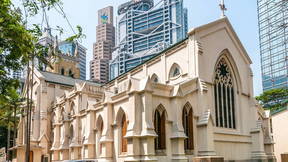
St John’s Cathedral
The oldest surviving Western Cathedral building for 170 years
Cross-shaped structure and a tall front tower
Features English Gothic architecture that was popular in the 13th-century
Such as pointed arches and extensive use of stained glass
History
1842 - the British started to build an Anglican church building after controlled the area of Hong Kong
1849 - finished construction
1873 - extended
1941~1945 Japanese occupation, used for a club
1996 - Declared a monument by the Hong Kong government
Duddell Street Steps and Gas Lamps
Built between 1875 and 1889 with a flight of stone steps
Named in honor of brothers George and Frederick Duddell
Four gas street lamps are situated at the top and foot of the steps
The only surviving working gas street lamps in Hong Kong since 1967
Still operated from 6pm-6am everyday
Three of the four street lights have been destroyed in 2018 during Typhoon Mangkhut
Repaired by late 2019
Dr Sun Yat-sen Museum
- Located in Kom Tong Hall, at 7 Castle Road Central
- Opened on 20 December, 2006 for commemorating the 140th birthday of Dr Sun Yat-sen
- Honoring Chinese revolutionary figure Dr Sun Yat-sen
Dr Sun Yat-sen
- 12 November 1866-12 March 1925
- Chinese statesman, physician, and political philosopher
- Xinhai Revolution
- used Hong Kong as a base of his revolutionary campaign from 1894 to 1912
History of Kom Tong Hall
- 1914: Named after the former owner Ho Kom-tong
- 1960: The Church of Jesus Christ of Latter-day Saints purchased it
- 1990: Accorded a Grade II historical building
- 2006:Opening day of Dr Sun Yat-sen Museum
Architecture
- A four-storey museum
- Typical Edwardian classical building
- One of the few surviving structures in Hong Kong built in the early 20th century
- The main staircase and other prominent locations use stained-glass windows to decorate
- The facade of the top two floors is supported by the Greek-style granite columns surrounding the curved balconies
Exhibitions and Facilities
- “Dr Sun Yat-sen and Modern China”
- “Hong Kong in Dr Sun Yat-sen's Time”
- Other facilities: reading room, video rooms, interactive study rooms and an activity room
Opening hours
- Monday to Wednesday, Friday:10am-6pm
- Saturday, Sunday and public holidays:10am-7pm
- Christmas Eve and Chinese New Year's Eve: 10 am - 5 pm